The Difference Between Web Designing and Web Developing
The Difference Between Web Designing and Web Developing
03 Mar 2020 19:41 (Updated for 2026 Industry Standards)
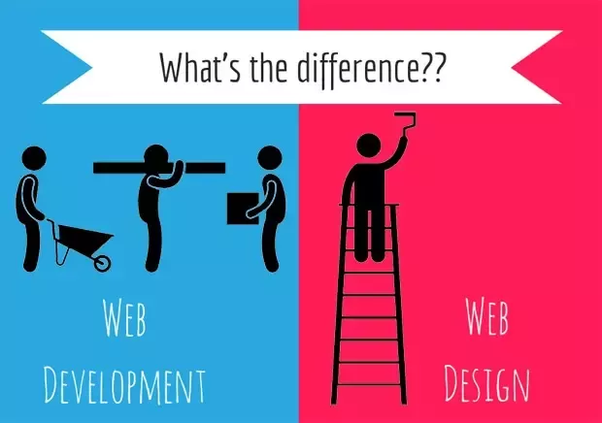
There is a common confusion that web designing and web developing are the same things. In reality, they are two distinct disciplines that require different skill sets. While a designer focuses on how a site looks and feels, a developer focuses on how it functions. By the end of this post, the line between these two roles will be crystal clear.
🎨 What is a Web Designer?
The Web Designer is the creative force. They are responsible for the layout, visual aesthetics, and user experience (UX) of the site. They take a company’s vision and translate it into a functional, appealing interface.
Core Focus: Web graphics, interface design (UI), color schemes, and SEO.
The Goal: To make the website intuitive and visually engaging so that users want to stay.
The Designer's Toolkit
Designers primarily use software that helps them visualize the final product without necessarily writing the backend logic:
Graphics & Layout: Adobe Photoshop, Illustrator, Inkscape, or GIMP.
Prototyping: Adobe Fireworks, Figma, or Adobe XD.
Browsing & Analysis: Firefox Developer Edition and analytics tools.
💻 What is a Web Developer?
The Web Developer is the architect and engineer. They take the designer's static layouts and turn them into a living, breathing system using code.
Core Focus: Programming languages, database management, and system architecture.
The Goal: To build a fast, secure, and reliable application that follows the company's technical specifications.
The Developer's Toolkit
Developers rely on environments that allow them to write, test, and deploy clean code:
Code Editors: Visual Studio Code (VS Code), Atom, Sublime Text, or Vim.
Web Frameworks: Django (Python), Ruby on Rails, ReactJS, Vue.js, or Angular.
CSS Frameworks: Bootstrap, Tailwind CSS, or Materialize.
Package Managers: NPM or Yarn.
🏗️ Portfolios: Visuals vs. Repositories
You can tell the difference between these two roles just by looking at their work history:
Designers: Their portfolios are visual galleries showcasing creativity, typography, and color theory on sites like Behance or Dribbble.
Developers: They showcase "repositories" (like GitHub) that prove their ability to write elegant, readable, and refactored code.
🧠 Left-Brain vs. Right-Brain: A Modern Take
It is often said that developers are "left-brained" (logical) and designers are "right-brained" (creative). However, modern studies suggest this binary is a myth. As Neil deGrasse Tyson says, "Call me human." An artist can become a master of logic-heavy Python, and a mathematician can design a stunningly creative UI. Don't let labels limit which side of the "puzzle" you choose to work on.
The "Do's" of a Great Website:
Consistency: Keep the interface and fonts uniform.
Usability: Label buttons correctly and ensure easy navigation.
Responsive: Ensure the site works on every screen size.
Security: Sanitize user inputs and encrypt sensitive data.
Conclusion
A successful website requires both a visionary designer and a precise developer. One builds the "look," and the other builds the "engine." When these two roles are executed perfectly, the result is a high-performance digital experience.
🚀 Ready to Build Something Great?
Whether you need a creative redesign or a complex custom-coded system, our team bridges the gap between design and development. To see how we can bring your digital project to life, visit us at https://iformatlogic.com/. At iFormatLogic, we master both the art and the code.